
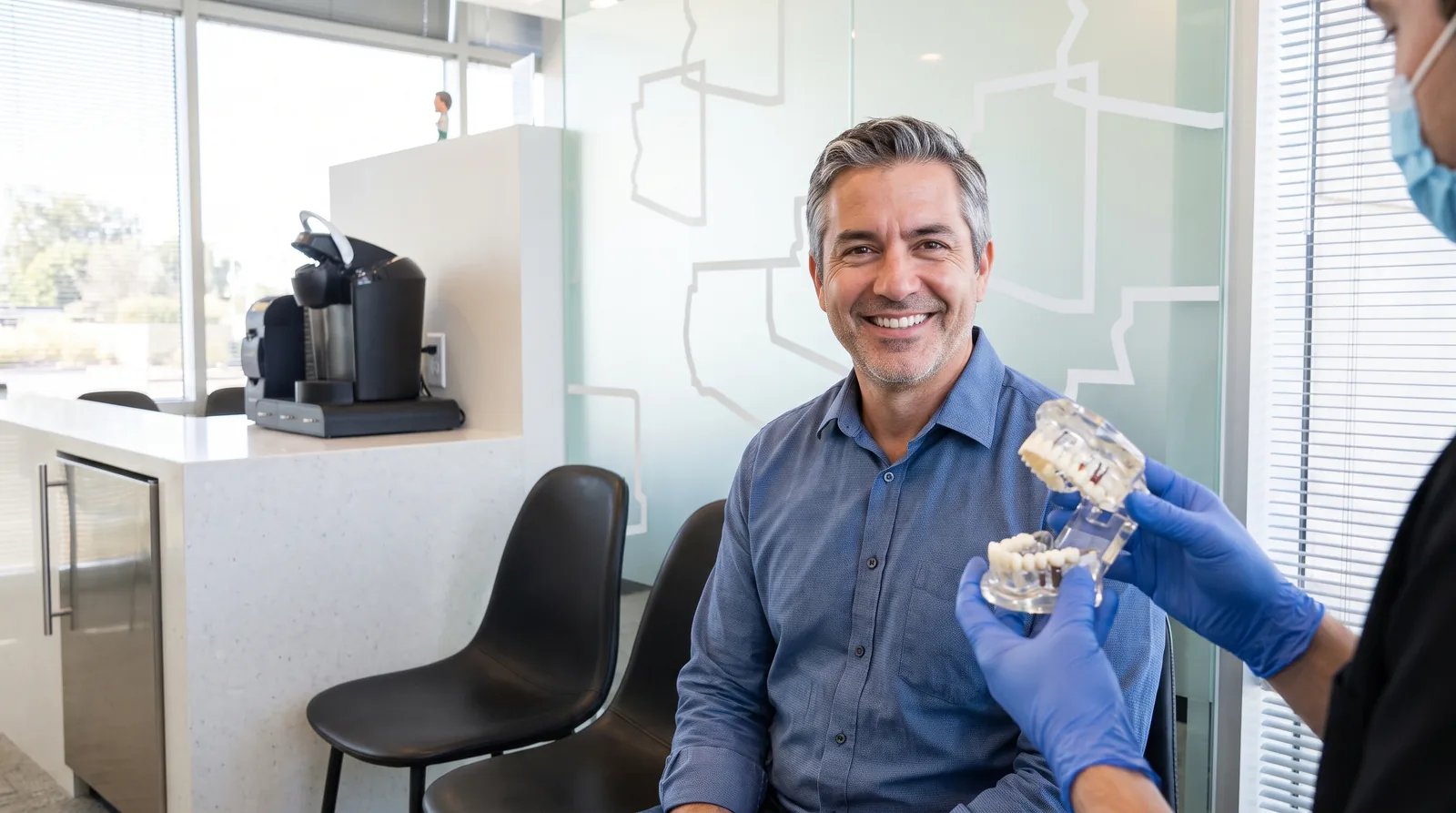
Replace What Is Missing Without Compromising What Remains
A missing tooth changes more than the way your smile looks. It can affect chewing, speech, the position of nearby teeth, and the bone that once supported the tooth. A dental implant replaces the root portion beneath the gums and supports a natural-looking restoration above it.
Arizona Biltmore Dentistry provides start-to-finish dental implant care in Phoenix. Our dental team coordinates your evaluation, detailed imaging, implant placement, and final restoration within the same practice. Keeping those steps coordinated can make a complex process easier to understand.
How Dental Implants Can Help
An implant is a small post placed in the jaw to create a stable foundation. After the area heals, the implant can support a crown, bridge, or denture, depending on how many teeth need to be replaced.
Single-Tooth Replacement
A single implant and crown can fill one gap without relying on the neighboring teeth for support. The final crown is shaped to work with your bite and blend with the surrounding smile.
Multiple Missing Teeth
An implant-supported bridge uses two or more implants to hold a row of replacement teeth when several teeth are missing together. This approach may reduce the need for a removable partial denture and can provide a stable chewing surface.
Denture Stabilization and Full-Arch Care
Several implants can help secure a denture or support a fixed full-arch restoration such as All-on-X. These options are designed to reduce movement and give people with extensive tooth loss more confidence in daily life.
Immediate Placement After Extraction
When a tooth needs to come out and the surrounding bone is healthy, it is sometimes possible to place the implant at the same visit as the extraction. This can shorten the overall timeline and reduce the number of procedures. It is not appropriate for every site, and CBCT imaging helps us decide.
Restoring Implants Placed Elsewhere
If an implant was placed by another office or in another city and you need the crown or denture completed, we can help. We coordinate with the placing office to obtain your implant records, including the brand and size, so the correct components are used.
Benefits of Implant Treatment
- A secure foundation that does not depend on adhesive
- A restoration designed to look and function like part of your smile
- Support for comfortable speaking and chewing
- Stimulation that helps maintain the jawbone around the implant
- Daily care that is similar to caring for natural teeth, with instructions based on the restoration
Implants are an investment and require ongoing care. They are not the only tooth-replacement option, and they are not right for every person. We will compare implants with bridges and dentures so you can consider health, timeline, upkeep, and cost together.
A traditional bridge is anchored to the neighboring teeth, which must be reshaped, and can usually be completed faster. A removable partial denture is the most economical choice, but it rests on the gums and nearby teeth and must be taken out for cleaning. An implant stands on its own, leaves the neighboring teeth untouched, and helps preserve bone, but it costs more up front and takes longer. For extensive tooth loss, All-on-X and implant-supported dentures offer additional options.
What to Expect From the Implant Process
Consultation and 3D Planning
We begin with an exam, health review, and diagnostic images. The practice uses CBCT imaging and computer-guided planning to evaluate available bone and plan the implant position. If a damaged tooth still needs to be removed or the area lacks enough support, your plan may include extraction or bone grafting.
Implant Placement
The implant is placed in the planned position while the area is numb. Sedation options may be available if you are anxious or having a longer procedure. You will receive written instructions for the first part of healing.
Healing and Integration
The implant needs time to become stable within the surrounding bone. The length of this stage varies with the site, your health, and any supporting procedures. A temporary tooth may be possible in some situations, but it is not appropriate for everyone.
Final Restoration
Once the implant is ready, we connect the custom crown, bridge, or denture. We check the fit and bite, then show you how to clean around the restoration. Implants cannot decay, but the gum and bone around them can become inflamed, a condition called peri-implantitis, so daily cleaning and regular professional checks are part of long-term success.
Questions, Answered
Dental Implant FAQs
Am I a Candidate for Dental Implants?
Many adults with one or more missing teeth can be considered. Gum health, available bone, medical conditions, medications, tobacco use, and home care all affect planning. An exam and 3D images are needed for a personal answer.
Is Implant Treatment Painful?
The placement area is numbed, and sedation options may be available. Tenderness after treatment is normal, but the experience varies. We will explain what to expect and how to contact the office if something does not feel right.
How Long Does the Process Take?
The timeline can range from a few months to longer when extraction, grafting, or additional healing is needed. We provide an estimated sequence after evaluating your specific case.
How Long Can Dental Implants Last?
With healthy gums, good home care, and regular professional visits, implants can serve for many years. The restoration attached to the implant may need maintenance or replacement over time.
How Much Do Dental Implants Cost?
Cost depends on the number of implants, the restoration, diagnostic planning, and whether extraction or grafting is needed. We provide an itemized plan and review insurance and financing options before treatment begins.
How Do I Care for an Implant?
Brush twice a day, clean around the implant daily with floss, a water flosser, or the small brushes we recommend, and keep up with professional cleanings. We check the gum and bone around each implant at your regular visits. Avoid tobacco, and call if you notice bleeding, swelling, or looseness.
What If I'm Not Ready for an Implant?
That is fine. A bridge, partial denture, or a simple space maintainer can hold the space while you decide, and if a tooth is being removed, a bone graft at the time of extraction can help preserve the site for a future implant. We will explain what each choice means for later options.